

If you run a diesel repair shop, manage a trucking fleet, or dispatch mobile techs, you’ve probably had that gut-wrenching moment at the end of the month. You look at the total revenue: it’s a big number. You look at the bank account: it’s… not as big as you expected.
You start doing the mental math. "I’m charging $150 an hour for labor. I’m paying my lead tech $45 an hour. That’s $105 in profit every time he turns a wrench, right?"
Actually, it’s probably not. In fact, if that’s how you’re calculating your labor margin, you aren’t just guessing: you’re flying blind through a fog bank without radar.
At 3B Bookkeeping, we see this all the time. Service business owners are experts at their craft, but when it comes to the "financial recon" required to find their true labor margin, things get blurry. Most owners are off by 20% to 30% on their actual costs. When you’re running a high-overhead operation like a heavy-duty repair shop, that 30% error isn't just a rounding error: it’s the difference between scaling your fleet and wondering why you can’t afford a new service truck.
The "Back of the Napkin" Trap
The most common mistake in the service industry is the "Spread Calculation." This is when you take your billable rate and subtract the hourly wage of the technician.
- Billable Rate: $140/hr
- Tech Pay: $40/hr
- Perceived Margin: $100/hr (71%)
On paper, this looks like a gold mine. In reality, it’s an April Fools' joke that lasts all year long. This calculation ignores the "Labor Burden": the actual cost of keeping that human being on your shop floor or in that mobile unit.
In the Marine Corps, we were taught that "slow is smooth, and smooth is fast." Precision matters. If you don't have precision in your bookkeeping, you’re making tactical decisions based on bad intel. Let’s break down what’s actually eating that $100 margin.
What is "Labor Burden" (The True Cost of a Tech)
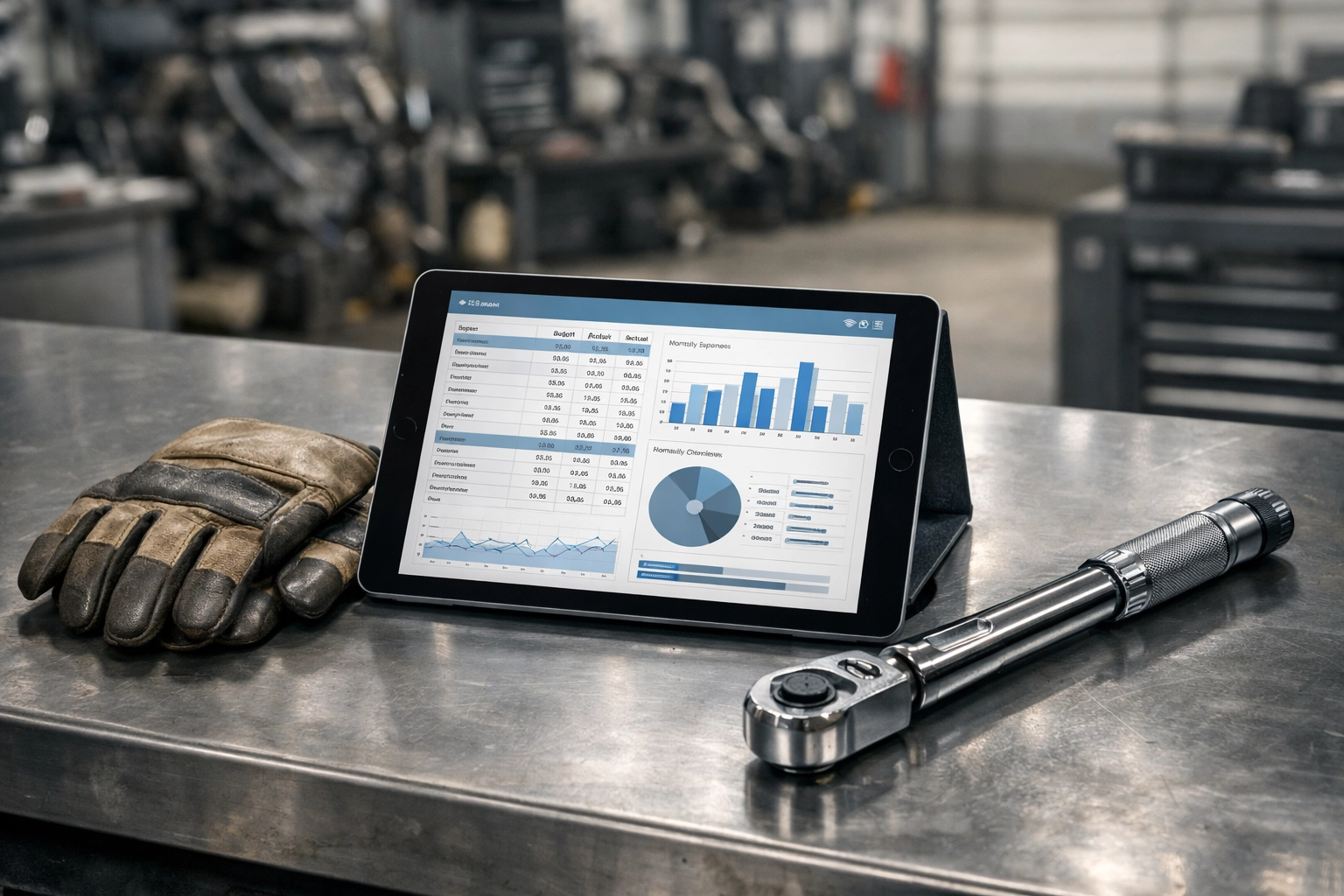
To get to your true labor margin, you have to look at the "Fully Burdened" labor cost. This is the total amount of money it costs your business to provide one hour of labor to a customer.
Here is what most diesel shop and fleet owners forget to include:
- Payroll Taxes: FICA, SUTA, and FUTA. You aren’t just paying the tech; you’re paying the government for the privilege of paying the tech.
- Workers' Comp: In heavy-duty repair and trucking, these rates aren't cheap. A tech working on a Class 8 engine is a higher risk than a guy behind a desk, and your insurance premiums reflect that.
- Benefits: Health insurance, 401k matching, and life insurance.
- Paid Time Off (PTO): When your tech is on vacation or home with the flu, you’re still paying for that time, but you have zero revenue coming in to offset it.
- Uniforms and Safety Gear: Boots, branded shirts, shop rags, and PPE.
- Training and Certifications: Keeping your techs up to date on the latest Cummins or Detroit Diesel software isn’t free.
When you add these up, that $40/hr tech actually costs you closer to $55 or $60 per hour. Suddenly, your $100 margin has shrunk to $80: and we haven’t even talked about the biggest profit killer of all: Productivity.
The Productivity Gap: Why 40 Hours ≠ 40 Billable Hours
This is where the wheels usually fall off the wagon for mobile techs and shop owners. You pay your tech for 40 hours a week. But how many of those hours are actually spent on a billable invoice?
Think about a typical day in a diesel shop:
- Moving trucks in and out of the bays.
- Cleaning up an oil spill.
- Looking for a specialized tool that someone didn't put back.
- Waiting for the parts runner to show up with a turbocharger.
- Filling out service reports and administrative paperwork.
In many shops, billable efficiency (the percentage of hours worked that are actually charged to a customer) hovers around 70% to 75%.
If you pay a tech for 40 hours ($1,600 at $40/hr) but they only bill 30 hours, your effective cost per billable hour just jumped to $53.33. Now, add back in that labor burden we talked about earlier. Your true cost to put that tech in front of a customer might be $75 or $80 per hour.
If you’re still thinking your margin is $100/hr, you are missing the fact that nearly half of that is already gone before you even pay your shop rent or electric bill. For more on how these numbers drive your profit, check out our guide on Diesel KPIs.
Why "Industry Standard" Pricing Is a Dangerous Game
A lot of owners set their labor rates by calling the three shops down the road and asking what they charge.
"The guy across town is at $130, so I’ll stay at $130."
Here’s the problem: You don't know that guy's books. He might own his building outright while you’re paying $8,000 a month in rent. He might have a crew of C-level techs while you’re paying top dollar for A-level master mechanics. He might be six months away from bankruptcy because he doesn’t know his labor margin either.
Basing your pricing on the "other guy" is like following a random vehicle in a convoy without checking the map. You might both be driving off a cliff.
Precision in financial reporting means knowing your overhead, your burden, and your efficiency. This is why a general bookkeeper might be costing you money: they don’t understand the specific nuances of the diesel and service world. We’ve written about this in depth here: Why a General Bookkeeper is Costing Your Diesel Shop Money.

Tactical Steps to Find Your Real Labor Margin
If you want to move from guessing to knowing, you need to implement a "Mission Ready" bookkeeping system. Here is how we approach it at 3B Bookkeeping:
1. Job Costing is Non-Negotiable
You must track labor hours against specific jobs. If a brake job on a Kenworth is quoted for 4 hours but takes 6, you need to know why. Was it a rusty bolt, or is your tech losing efficiency? Without job costing, you can’t see which types of work are making you money and which ones are just "busy work" that eats your profit.
2. Audit Your Non-Billable Time
Start tracking what your techs are doing when they aren't wrenching. If they are spending 10 hours a week chasing parts, it might be cheaper to hire a $15/hr driver so your $45/hr tech can stay in the bay. You can't make that call without the data.
3. Review Your Burden Quarterly
Insurance rates change. Taxes shift. Benefits costs go up. If you calculated your labor burden two years ago, it’s out of date. At 3B Bookkeeping, we help our clients keep these numbers current so their labor rates vs. actual profit stay aligned.
The Cost of Not Knowing
What happens if you keep guessing?
You might find yourself "busy" but broke. You’ll see the bays full every day, your team working overtime, and yet there’s never enough cash to upgrade your diagnostic software or buy that new service truck.
In the trucking and repair world, your labor is your product. If you don't know the exact cost of goods sold for that product, you can’t price it correctly. You might be winning the "low price" game but losing the "stay in business" war.
Knowing your labor margin gives you the confidence to:
- Raise your rates when necessary.
- Hire more techs because you know exactly how much they contribute to the bottom line.
- Turn away low-margin work that clogs up your shop.
Final Thoughts: Get Your Financial Recon in Order
Operating a service business without knowing your labor margin is like driving a heavy-haul rig with a broken fuel gauge. You might be moving fast now, but you’re going to run out of gas at the worst possible time.
At 3B Bookkeeping, we don't just "do the books." We provide the financial intelligence you need to lead your business with confidence. We specialize in the service industry: the folks who get their hands dirty and keep the country moving.
Don't wait until tax season to realize your margins were razor-thin. Check out why waiting for tax season is an operational failure and start getting your numbers mission-ready today.
Need a trusted financial battle buddy? Schedule your free 30-minute consult here:
https://calendly.com/estle-chad/30min